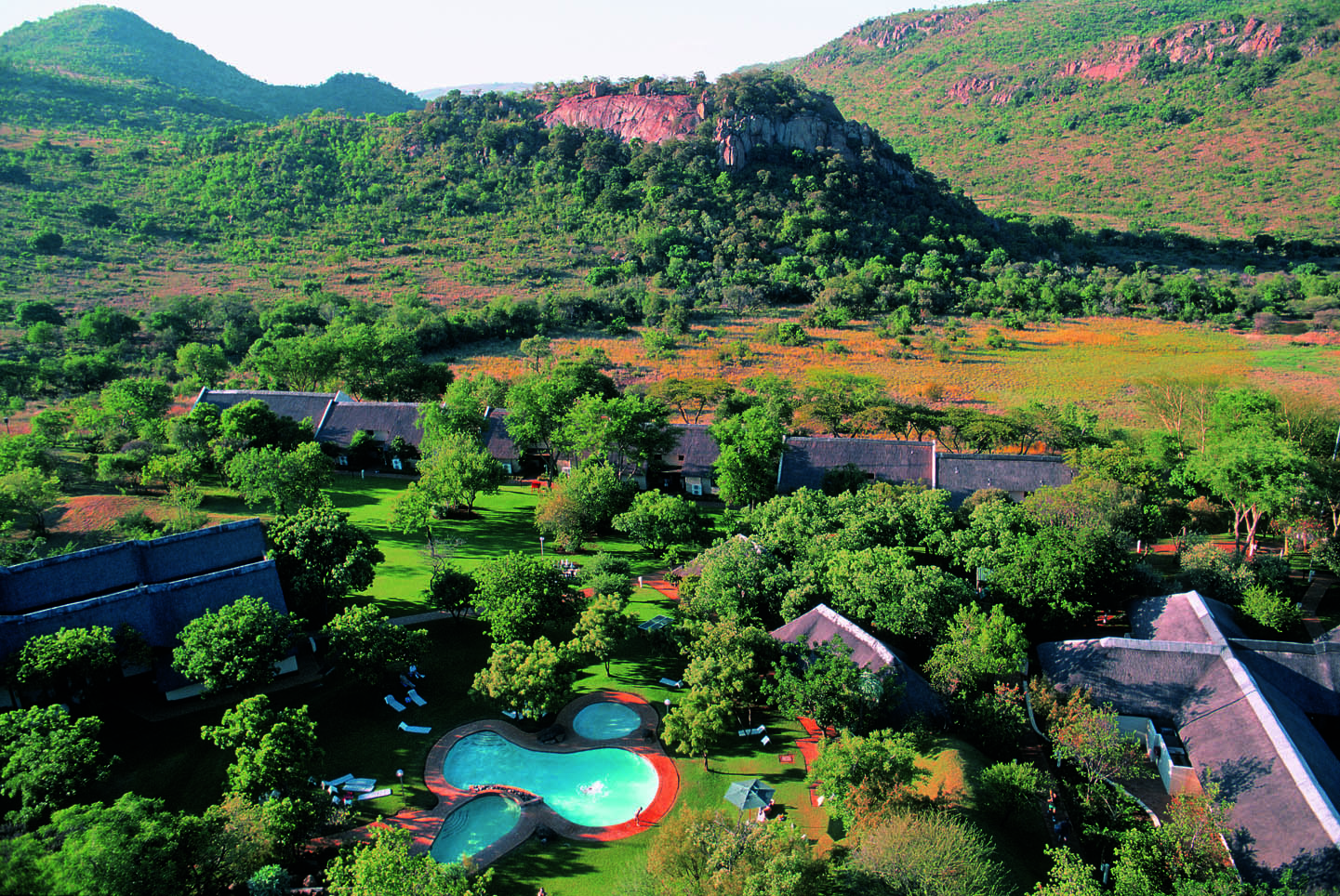


Luxury lodge safaris and tours to the Pilanesberg’s Bakubung, Kwa Maritane and Tshukudu Bush Lodges; Ivory Tree and Shepherd’s Tree Game Lodges and the Black Rhino Game Reserve’s Kgorogoro, Thaba and Buffalo Thorn Game Lodges.
Visit our Pilanesberg Safari Lodge Accommodation page to find out further information about the amazing safari lodges available. Send us a quick enquiry there and we’ll revert to you shortly with your obligation free quote!
Collection at approximately 08h00 we make our way straight for the Park. Upon arrival we embark on a slow drive into the Pilanesberg Ring Complex to see what nature has to offer. We have lunch at a nice picnic spot within the Park and then make our way to the lodge to check in and meet the lodge staff that will be looking after you. That afternoon you embark on an Open Game Vehicle Drive guided by a Lodge Ranger, returning after dark with spotlights to track down those nocturnal predators. Once back at the lodge you enjoy a delicious meal at the Lodge after which you can relax in the bar or simply enjoy an early night in preparation for the following day. (L, D)
This morning you wake early for coffee and rusks and head into the Park for opening time to catch the predators before they rest up for the day. You return to the Lodge at about 10h00 for a buffet breakfast. The remainder of the morning and early afternoon can be spent at leisure relaxing by the pool, in the spa or simply bird and monkey watching. Another Open Game Vehicle Drive in the afternoon will allow you the chance to see any animals not yet seen as well as the chance to focus on some of the smaller things in the Bush. (B, L, D)
Waking early again you can enjoy a guided walk (depending on availability and at an additional cost) where you may have encounters with birds and the bigger game as well as enjoying the less emphasised aspect of the African Bush; The Bush itself. Otherwise, a Game Drive to catch any members of the bigger animals still eluding is the option. Following this you have a buffet breakfast back at the lodge, where you will be met by your Pilanesberg Safaris guide and after some digestion time you pack up and we make our way back to Johannesburg, returning around 15h00. (B, L)
Highlights: Unique Pilanesberg Alkaline Ring Complex; Open Vehicle Big 5 Game Drives
Optional Activities: Sun City; Balloon Safaris; Walking Trails
For any other Luxury Lodge Safaris to any destination in Southern Africa please feel free to contact us and we’ll make the necessary arrangements for you.

Welcome to PilanesbergThe only settlement from the pre-park farming era that survived when the Pilanesberg was established. Built in 1936 as a courthouse and jail, it now houses a coffee shop, restaurant and curio shop — a natural midpoint stop on any game drive.
The deck has sweeping views across the central ring complex, and a salt lick and small waterhole adjacent to the Centre attract game throughout the day. Rhino, Zebra and antelope can often be seen just metres away.
Another of Legacy’s bush properties, fully rebuilt and upgraded after a fire in 2008. City-standard comfort in a genuine bush setting, with well-trained guides and direct access to Tshepe Drive and some of the best game-viewing roads in the park.
The combination of quality accommodation, experienced guiding and a prime location in the eastern section of the Pilanesberg makes Kwa Maritane a strong choice for a luxury bush stay.
Part of the community-owned Golden Leopard Resorts, Bakgatla sits on the north-eastern boundary of the park, nestled against the outer volcanic mountains. Camping, caravanning, permanent tents and 3-star family chalets make it accessible at most budgets.
The Laps Health and Beauty Spa offers value-for-money treatments, and the location near Tshwene and Kgabo drives puts some of the best game-viewing corridors in the park minutes from the gate.
A 5-star lodge in the north-eastern section of the park with excellent facilities and twice-daily open vehicle game drives included in the accommodation rate — one of the better all-inclusive offerings in the Pilanesberg.
The award-winning Amani African Spa has been recognised among the finest bush spa experiences in South Africa, and the lodge’s elevated position provides spectacular views across the volcanic ring complex.
The sister property to Bakgatla within the Golden Leopard Resorts group, Manyane is a family-focused resort on the north-eastern boundary offering camping, caravanning, permanent tents and a range of 2- and 4-sleeper chalets.
Mini-golf, pools, a bar and restaurant make it a destination in itself. Guests here benefit from some of the earliest morning access to the park — and early mornings in the Pilanesberg are invariably the best time to be on the road.
The most iconic landmark in the Pilanesberg — a man-made dam sitting in the collapsed central ring dyke of the ancient volcano, at the absolute geographic heart of the park. No visit is complete without time spent here, and no morning game drive ends without a stop at the water’s edge.
Resident Hippos and Crocodiles patrol the dam year-round, a remarkable diversity of birds fishes the shoreline, and Springbok, Zebra, Wildebeest, Warthog, Waterbuck and Ostrich are all regularly seen drinking. On any given morning, Mankwe Dam delivers the most spectacular sightings in the park.
The Pilanesberg is one of the only Big Five reserves in the world situated entirely within a malaria-free zone. No prophylactic medication, no nets, no health precautions beyond sun protection — every guest, from young children to grandparents, can visit in complete safety year-round.
The park sits at approximately 1,100 metres on the South African highveld, where the altitude and dry winters prevent the Anopheles mosquito from surviving. It’s one of the most compelling reasons to choose the Pilanesberg — world-class Big Five wildlife without the health considerations of tropical Africa.
The main access road from Kwa Maritane Lodge, Tshepe Drive passes the base of Slagterkop — Slaughter Hill — where tribal chiefs once executed cattle thieves and accused witches by throwing them from the cliff face. Legend has it that the tears of the condemned still streak down the rock face today.
Beyond the history, Tshepe Drive is one of the most productive roads for Lion and Elephant sightings. The combination of rich cultural storytelling and reliable Big Five game viewing makes it a favourite with guests who want more than just wildlife.
Korwe means Hornbill in Setswana. Iron Age stone walls dating to the 17th century are visible along this road — the remains of settlements built at the base of hills so that lookouts posted at the summit could spot enemies without being seen. One of the most tangible connections to pre-colonial history in the park.
From several points along Korwe Link, sweeping views open across the full breadth of the ring complex. Lone Elephant bulls and breeding herds move through the wide valley below, and the birding here is excellent.
A fine example of gully thicket forest where two hillsides meet — dense, ancient woodland that has established itself along the drainage line. These thickets are among the most biodiverse micro-habitats in the park.
Prime territory for Leopard, Kudu and Bushbuck. The birding is equally exceptional — a concentration of forest-dependent species found nowhere else in the Pilanesberg. This is a road that rewards slow driving and open windows.
A long winding route through the north-eastern section, comprising thick thornveld that shelters two nationally protected tree species — the Shepherd’s Tree (Boscia albitrunca) and the Stink Shepherd’s Tree (Boscia foetida). Their presence makes this road botanically significant.
Black Rhino, Elephant and Lion are all seen here regularly, and the resident Hippos in Malatse Dam are a reliable highlight. One of the more secluded and rewarding circuits in the northern reaches of the park.
Named after the Nkakane peak — one of the highest points in the volcanic ring at over 1,380 metres — this link road connects Tshepe Drive to Tshukudu e’Ntsho Drive through the rugged eastern highlands.
The elevated terrain offers dramatic views across the ring complex, and the varied habitat along the route — rocky ridges, thicket and open slope — creates ideal conditions for Leopard, Black Rhino and Elephant. One of the more adventurous circuits for guests wanting to explore beyond the main park roads.
Recently incorporated into the greater Pilanesberg, Black Rhino Game Reserve adds nearly 2,000 hectares of exclusive wilderness to the park. A collection of privately owned, exclusively booked 10-sleeper lodges makes this one of the most private Big Five experiences available in South Africa.
Black Rhino was one of the first private land additions towards the Heritage Park — an ambitious corridor that will ultimately link the Pilanesberg with Madikwe. Guests access the full 200 km road network in private open vehicles through a secluded wilderness valley.
A 5-star lodge set within an exclusive-use zone in the south-western section of the park. Award-winning spa, gourmet restaurant, open-air boma and individually styled suites all deliver uninterrupted views across a sweeping bushveld amphitheatre.
Its proximity to one of the Pilanesberg’s Wilderness Areas makes it one of the few lodges offering guided walking safaris in the park — a rare and extraordinary experience to complement the standard game drive.
A small, intimate bush retreat that prioritises atmosphere and seclusion above all else. The Nest — an elevated sundowner platform — offers one of the most romantic sunset views in the Pilanesberg, while the traditional boma beneath the stars is perfect for an evening of stories from the bush.
For guests wanting a truly authentic African lodge experience combined with access to the full Pilanesberg road network, Tshukudu delivers privacy and quality in equal measure.
A flagship 5-star property in Legacy Hotels’ portfolio, situated in the south-western section of the park. Beautifully appointed, fully equipped and with a resident waterhole overlooked by the deck — the game viewing never really stops.
The midday buffet lunch at Bakubung has become a highlight of full-day tours with Pilanesberg Safaris and Tours — consistently excellent and generous enough to keep the hungriest guest satisfied.
Built in the 1980s on the edge of what would become the Pilanesberg National Park, Sun City remains one of Africa’s most iconic entertainment destinations — wave pools, championship golf, casinos, diverse hotels and restaurants, all within the ancient volcanic ring.
Guests access the park directly through Sun City’s own gate. The Adventure Centre offers quad biking, game drives, archery and clay pigeon shooting — making it an ideal base for families wanting both safari and resort experiences.
The rocky outcrops along Thlware Road are prime basking spots for Yellow-spotted Rock Hyrax — better known as Rock Dassies. What looks like a large rodent is actually one of the Elephant’s closest living relatives, a fact that never fails to surprise guests.
Where Dassies thrive, their predators follow. Thlware is one of the better roads in the park for spotting African Rock Python, Verreaux’s Eagle and Leopard — three species that actively hunt the rocky terrain.
Tau means Lion. This road in the north-west is defined by the remarkable Common Tree Euphorbias (Euphorbia ingens) that tower above the bush — distinctive candelabra-shaped trees unique to this corner of the park. Black Rhino have been recorded feeding on them, and the San historically used their toxic latex to poison arrowheads.
Giraffe and Steenbok are frequently seen along the road, and the hidden Tau Pan waterhole rewards patient visitors with exceptional close-range sightings. One of the most characterful and story-rich roads in the Pilanesberg.
A short loop hugging the northern shore of Mankwe Dam, offering some of the best aquatic and predator sightings in the park. Hippos are virtually guaranteed — surfacing and submerging with that territorial grunt that signals their presence long before you see them.
Crocodiles line the banks in the warmer months, a wonderful variety of aquatic birds fishes the shoreline, and early morning drives frequently produce predator sightings as Lion and Leopard come down to the water’s edge. A firm favourite with returning guests.
Tshwene means Baboon. The main road from Manyane and Mogwase into the heart of the park, it sweeps through a dramatic transition from the outer volcanic mountains into the open grasslands of the central complex.
It’s the road most guests experience first — and it rarely disappoints. The diversity of habitat along Tshwene reflects the biodiversity of the Pilanesberg as a whole, and it remains one of the most reliable corridors for game throughout the day.
Kgabo means Vervet Monkey in Setswana. The main road from the Bakgatla gate to the Pilanesberg Centre, it is one of the most consistently productive routes for Big Five sightings in the park — White Rhino, Tsessebe and Giraffe are seen on almost every drive.
Rathlogo Waterhole is a must-visit stop along this road. Patience here regularly produces close sightings of Rhino, Kudu and Bushbuck — the kind of unhurried, authentic wildlife encounter the Pilanesberg does better than almost anywhere.
Thutlwa means Giraffe in Setswana, and the tall open bushveld here is ideal Giraffe habitat — extended sightings of these animals browsing at canopy level are commonplace. Dry stone kraal walls from the pre-park farming era are visible along the road, adding a layer of human history to the drive.
White Rhino enjoy the grazing year-round, and during the drier months Buffalo herds move down to Rathlogo Hide — a waterhole that consistently produces multi-species sightings in the late afternoon light.
Letsha in Setswana refers to a pool or standing water — an apt name for a road that winds through the waterhole-dotted southern section of the park. Waterholes draw a steady parade of wildlife throughout the day, and patience here is invariably rewarded.
Accessible via Kubu Drive, Letsha Road is a quieter route that delivers White Rhino, Giraffe and plains game sightings. Guides often combine it with Kubu Drive for a thorough loop through the productive southern corner of the Pilanesberg.
Mankwe Way follows the inner ring of the volcanic complex through terrain where the grasses are naturally less palatable — which means game is less predictable and the sightings, when they come, feel earned.
Resident Leopard patrol this road, Elephant herds pass through regularly, and Lions have been tracked along the route. It’s the kind of road that can deliver the best sighting of the day — or simply offer a quiet, beautiful drive through the heart of the park.
Black Rhino in Setswana — and this road lives up to the name. It’s one of the most promising routes in the park for encountering Africa’s critically endangered Black Rhino, with fewer than 6,000 left on the continent. A sighting here is genuinely special.
The dense thornveld provides the browse and cover that Black Rhino need. Lion and Leopard are also regularly encountered along this inner ring road — one of the most rewarding circuits in the park for serious wildlife enthusiasts.
Lenong means Vulture in Setswana. At one of the highest points in the park, the full scale of the ancient alkaline ring volcano stretches out in every direction — a view that no photograph truly captures and no visitor forgets.
Wildlife is surprisingly active even at this altitude. Zebra, Leopard and Elephant all move through, and a resident pair of Klipspringer antelope are often seen balancing on boulder tops with their young — the sure-footed acrobats of the Pilanesberg.
One of the best roads in the park for two of the Big Five — Cape Buffalo and White Rhino. Rhino can often be seen lying near the waterhole in the shade or grazing slowly through the open grassland, completely relaxed and at remarkably close range.
This accessibility is what makes Pilanesberg special. The park’s White Rhino have grown accustomed to vehicles, offering the kind of long, undisturbed sightings that wildlife photographers dream about. Sefara Way delivers those encounters consistently.
Kubu means Hippopotamus in Setswana. One of the main tarred roads in the southern section of the park, it links the Bakubung and Bakgatla gates through a landscape of rocky koppies, ravines and open grassland valleys.
Hippos are regularly seen at Synite Dam along this road, and the surrounding bushveld produces reliable sightings of Lion, Elephant and Black Rhino. A solid choice for a southern loop on any Pilanesberg safari.
Nare means Buffalo in Setswana — and this road earns the name as one of the best routes in the park for encountering Cape Buffalo, arguably the most dangerous and impressive of the Big Five at close range.
Large herds are an ecological cornerstone here, clearing the tall coarse grasses and creating grazing conditions for smaller antelope. Where Buffalo move, predators follow — making Nare Road a consistently rewarding circuit.
The key access road from the southern gates into the elevated plateau of the park, Kukama passes through a striking landscape of rocky koppies, ravines and open valleys — one of the most dramatic approaches into the Pilanesberg.
The varied terrain consistently delivers Big Five sightings. Lion, Elephant and Black Rhino are all encountered here with notable frequency, making Kukama Link one of the first priorities when heading in from the south.
Kgama winds through some of the most geologically dramatic terrain in the park, where exposed rock faces tell the story of the 1.2-billion-year-old alkaline volcano that formed this landscape. Guides use this road to bring that extraordinary history to life.
The wildlife matches the scenery — Leopard are regularly spotted among the rocky koppies, Hippos surface in the small dam before submerging with a grunt, and Elephant move through the valley. Geology and game viewing at their best.
Tlou means Elephant in Setswana, and this road through the central rings more than earns the name. White Rhino, Lion and Giraffe are seen regularly here, but it’s the Elephant herds moving silently between the ridges that define the experience.
Look out for the old rubbing post — a tree stump worn smooth over decades by Warthogs, Wildebeest and Rhino using it to scratch off ticks and parasites. It’s one of those small details that brings the daily life of the bush into sharp focus.
An active Brown Hyaena den is situated along this road — offering rare daylight glimpses of one of Africa’s most secretive nocturnal carnivores. Pilanesberg holds the highest density of Brown Hyaena in South Africa, largely because the Spotted Hyaena is absent from the park.
Seeing a Brown Hyaena is considered one of the ultimate wildlife highlights in the park. Shy, solitary and almost never encountered by casual visitors — guides who know where to look make all the difference.
Formerly known as Bailie Route, Moloto Drive sweeps through the remote western reaches of the park, skirting the protected Wilderness Area. The drier thornveld on this side means game is more spread out — but that also means far fewer vehicles.
After good rains, Eland, Sable and Roan Antelope move through alongside the predators that follow them. When a sighting happens out here, it’s almost always completely private — one of the best-kept secrets of a Pilanesberg safari.
Since 2007, PILANESBERGSAFARIS.COM, has led the market for all Pilanesberg National Park related services. We offer and arrange a number of exclusive safari experiences, led by passionate and qualified wildlife guides.
Allow us to safely show you and interpret this most beautiful unique extinct volcano, the Pilanesberg National Park, on our exclusive photographic safaris, our day tours and conservation minded activities.
Browse through and orientate yourselves on our homepage map. Explore the roads and points of interest or click the links below to view our safari packages.
We hope to be of further assistance.
Kamogelo,
Pilanesberg Safaris and Tours™.